
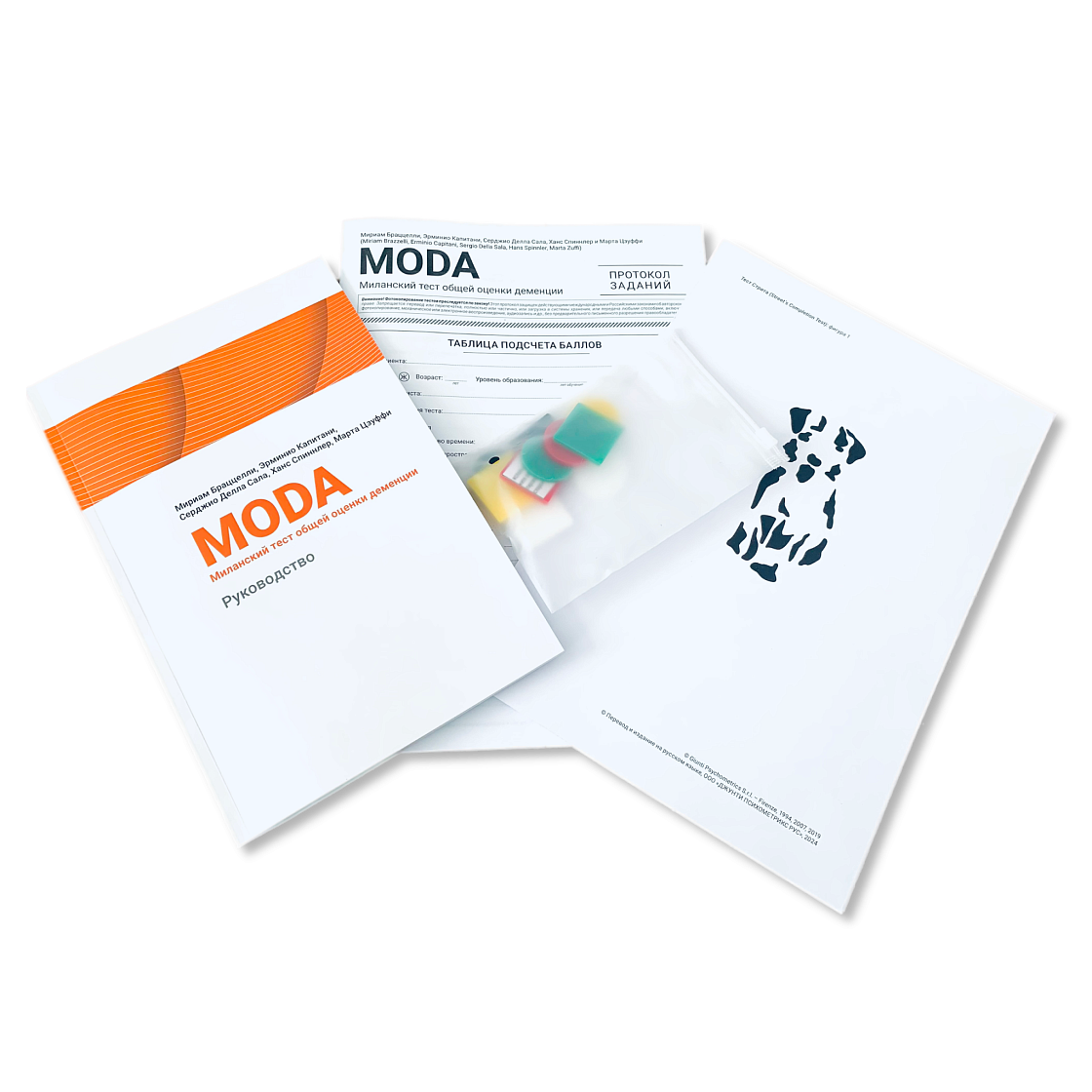
Milan Overall Dementia Assessment (MODA)
- Russian edition publication date
- 2024
- Russian-language adaptation
- Giunti Psychometrics Rus LLC
- Starter kit
- Guide, set of incentive materials, protocol of tasks 20 copies.
- Respondents
- Alzheimer's patients
- Completion time
- 30 to 60 minutes
- Copyright holder
- Giunti Psychometrics S.r.L. (Italy)
- Assessment authors
- Miriam Brazzelli, Erminio Capitani, Sergio Della Sala, Hans Spinnler, Marta Zuffi
The MODA test was designed and modeled to detect cognitive impairment associated with Alzheimer's disease, which quantifies the neuropsychological state of a patient suspected of having dementia, so that the test can detect cognitive impairment typical of Alzheimer's disease and assess its severity. The test is easy to use in clinical practice, including in bedridden patients.
The MODA test consists of 14 subtests and consists of three sections:
- “Orientation” – tests of orientation in time and space, on the knowledge of one’s own personality and one’s family.
- “Autonomy in everyday activities” – 5 subtests help to assess: gait, ability to dress, maintain personal hygiene, sphincter control and ability to eat independently.
- "Neuropsychological tests" - subtests include an assessment of the features of attention, verbal intelligence, retelling of the text, reproduction of a number of words, finger agnosia, constructive apraxia, completion of a holistic image.
The test allows you to predict the progression of Alzheimer’s disease, as well as convert the resulting test scores into MMSE test scores and back again.
The main limitations are related to the prevalence of verbal formulations of most subtests, due to which the results can be distorted in respondents suffering from total aphasia.
To do the test, you're going to need a task protocol, you're going to need incentive materials, and the formulas for numerating results are given in the manual.