
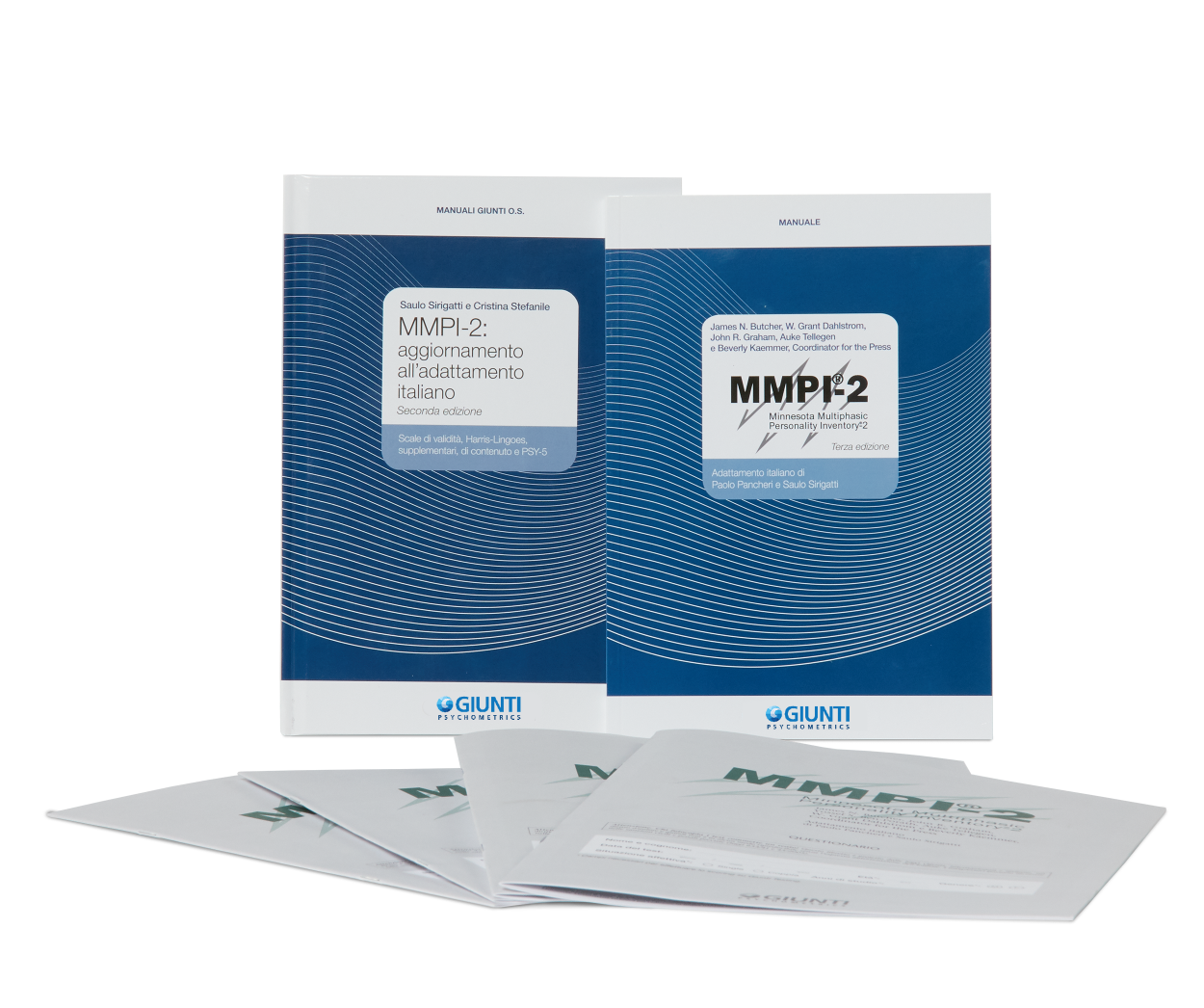
Minnesota Multiphasic Personality Inventory-2 (MMPI-2)
- Russian-language adaptation
- Giunti Psychometrics Rus LLC
- Starter kit
- 567-question questionnaire
- Respondents
- women and men aged 18 years
- Completion time
- 90 - 120 minutes
- Professional qualifications
- Diploma of higher education (specialty; master's degree; academic degree) in one of the following specialties: psychology, clinical psychology, medicine (neurology, psychiatry or pediatrics).
- Copyright holder
- University of Minnesota Press (USA), Pearson Assessments (USA)
- Assessment authors
- James N. Butcher, Ph.D., John R. Graham, Ph.D., Yossef S. Ben-Porath, Ph.D., Auke Tellegen, Ph.D., W. Grant Dahlstrom, Ph.D.
The Minnesota Multidisciplinary Personality Questionnaire (MMPI-2) is a multi-scale test designed to in-depth diagnose the psychological characteristics of adults, based on the MMPI-2 questionnaire (1941), which for fifty years has been considered the best clinically oriented test. The MMPI-2 version has made significant changes, added new indicators and scales, revised the way raw scores are converted into a standard indicator. MMPI-2 has been significantly refined to eliminate ambiguous diagnostic indicators and the impact of gender differences.
MMPI-2 is one of the most widely used questionnaires in the clinic and forensic psychiatry, designed for use by psychiatrists, psychologists, criminologists involved in advising lawyers, prosecutors and judges, because MMPI-2 is able to verify perpetrators, serial killers, pedophiles, drug addicts, etc.
The questionnaire can be freely used both individually and in a group. The technique allows you to identify traits and types of character with a high degree of reliability, determine the style of behavior and communication, diagnose the ability to adapt and hidden mental deviations, assess professional fitness, study the emotional state and severity of stress, predict the likelihood and content of difficulties in various types of work.
The questionnaire consists of 567 questions with dichotomous answers (yes/no). The questions are: eight validity scales, ten base scales, sixteen additional, fifteen substantive, five PSY-5 scales, 27 subscales related to content scales, 28 scales, 3 SI subscales (social introversion), Harris-Lingoes subscales.
- individual and family counselling;
- mass studies of certain population groups;
- career guidance, personnel recruitment, correction of production relations;
- examination of the psychological status and monitoring of the state of mental processes;
- psychological assessment of various types of correction and treatment;
- scientific research.