
Leiter International Performance Scale, Third Edition (Leiter-3)
- Russian edition publication date
- 2014
- Russian-language adaptation
- Giunti Psychometrics Rus LLC
- Starter kit
- Guide, set of incentive materials, 3 types of forms of 20 copies of each type
- Respondents
- Children over 3 years old and adults under 75 years old
- Completion time
- 30 to 40 minutes
- Copyright holder
- Stoelting Company (USA)
- Assessment authors
- Gale H. Roid, Lucy J. Miller, Mark Pomplun, Chris Koch
Leiter-3 is a modern test of nonverbal intelligence and cognitive function in adults and children from 3 years old.
In this method, all tasks are presented without the use of speech, making Leiter 3 an adequate tool for surveying groups of subjects for whom verbal instructions are too difficult to carry out. First of all, the Leiter-3 technique was developed for people with serious communication disorders, autism, mental development delay, learning difficulties, hearing disorders, attention deficit disorder, motor development disorders, traumatic brain injuries, a variety of neurological disorders of the elderly (for example, Alzheimer’s, Parkinson’s, dementia). In addition, the test successfully works with people for whom Russian is not their native language.
The Leiter-3 technique is used in both the pathology group and the normal group, and the test contains a wide range of complexity questions, so it can diagnose both mental retardation and giftedness.
The Leiter-3 consists of two subtest batteries:
- The Cognitive Subtest Battery (K Battery) consists of five subtests of nonverbal intellectual abilities related to visual processing and logical thinking. Four of these five subtests are required to determine nonverbal IQ (IQ).
- The attention and memory subtest battery also contains five subtests (two for the diagnosis of nonverbal attention, two for the evaluation of memory and one subtest for the study of cognitive interference of Stroop).
Subtests of the V/P battery can be used either alone or in conjunction with subtests of the K battery. Together, they form a non-verbal tool for detecting cognitive abnormalities in clinical and neuropsychological diagnostics, and include an expert rating scale that evaluates behavior during testing.
Leiter-3 not only allows timely detection of disorders of intelligence, attention and memory, but can also be used for research in dynamics, since subtests are sensitive to even small changes in cognitive function. Unlike other IQ tests, Leiter-3 measures only fluid intelligence, not crystallized intelligence, which allows you to assess the intellectual abilities and potential of a person, rather than their knowledge.
Leiter-3 has a high competitive validity with other standards of intelligence assessment, such as WISC-IV, WAIS-IV, Raven Matrix.
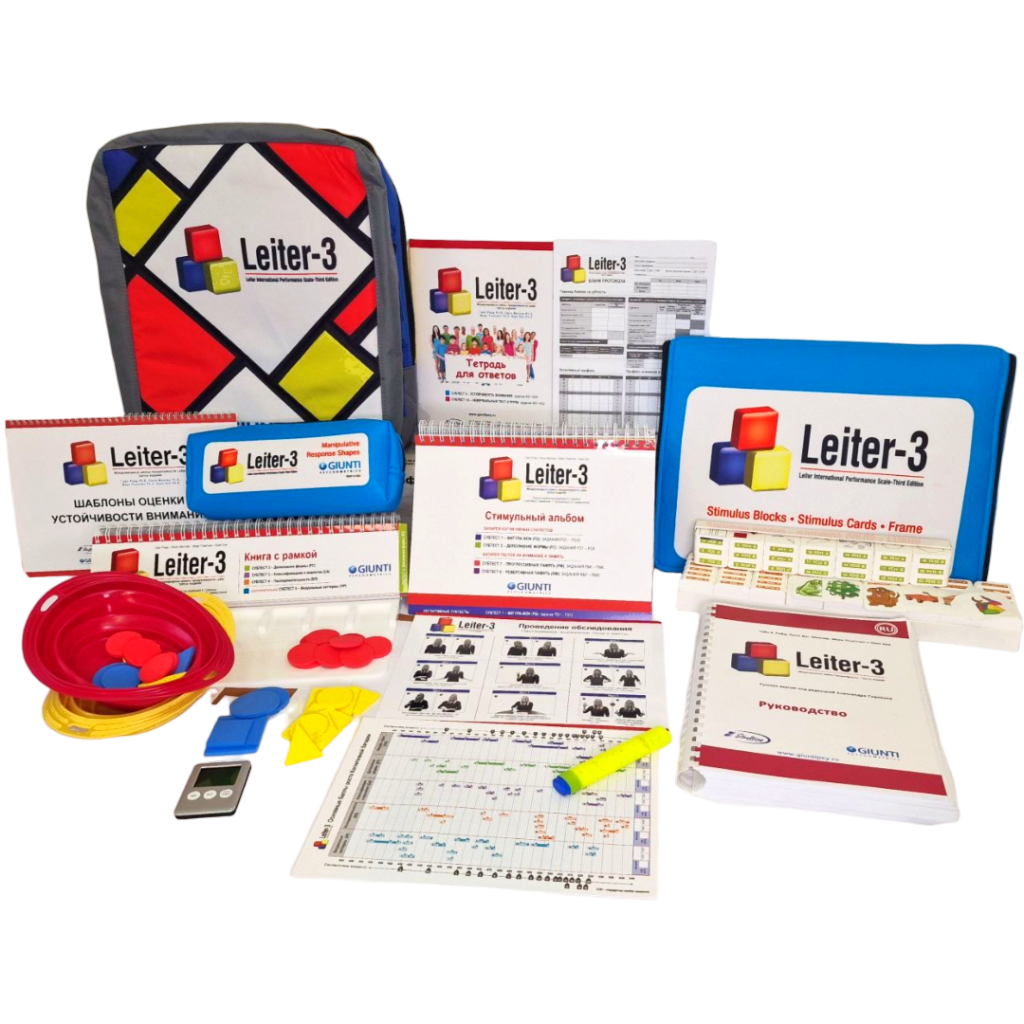
The test consists of a "Stimulus Album" with directions for a specialist, "Books with tasks" that also include instructions for a specialist, blocks that are inserted into a frame, cards and figures for manipulation. The test is safe and will last for a long time, including when working with people with special needs (no sharp corners, laminated pages, waterproof and elastic incentive materials).