
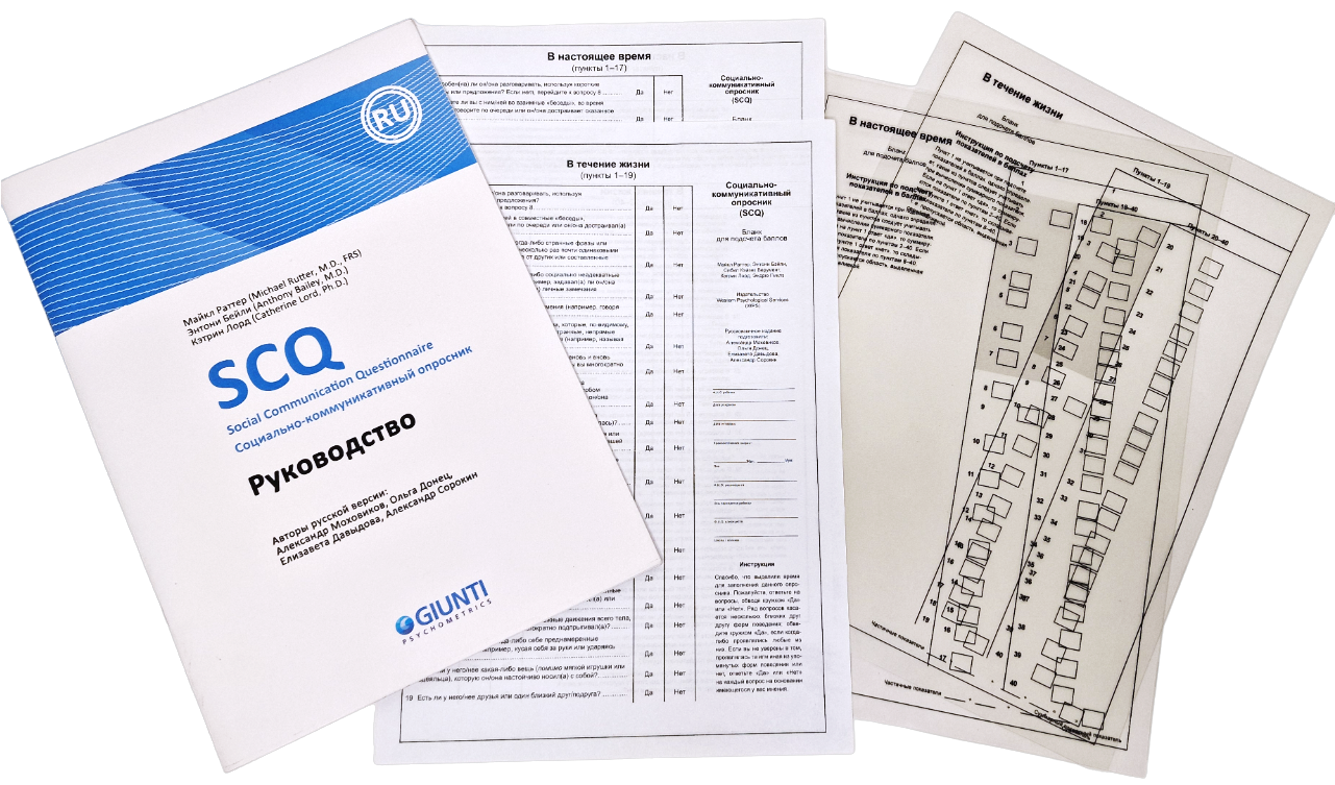
Social Communication Questionnaire (SCQ)
- Russian-language adaptation
- Giunti Psychometrics Rus LLC
- Starter kit
- Guide, two types of forms (25 copies each) and 2 keys for calculating the results
- Respondents
- Parents or legal representatives of children
- Completion time
- 15 minutes.
- Professional qualifications
- Diploma of higher education (specialty; master's degree; academic degree) in one of the following specialties: psychology, clinical psychology, medicine (neurology, psychiatry or pediatrics); it is recommended to undergo training in the practical application of the methodology.
- Assessment authors
- Michael Rutter, Anthony Bailey, Catherine Lord
SCQ (Social Communication Questionnaire) is a screening technique that helps identify symptoms associated with autism spectrum disorder (ASD).
The questionnaire is filled in by parents or guardians of children (chronological age over 4 years and mental age at least 2 years) for suspected autism spectrum disorder. The structure of the questionnaire consists of two forms of 40 questions each, with two alternative answers - "yes" and "no". It takes no more than 5-10 minutes to fill out each form, and about 5 minutes to count the results. The SCQ was originally developed as a companion screening technique to be used before using ADI-R (Autism Diagnostic Interview) and SCQ for differential purposes can be used before using ADOS-2. The SCQ questionnaire is a tool for quantifying ASD symptoms, whose threshold values are used to determine the likelihood of having ASD.
The questionnaire can be used for three purposes:
- In clinical practice, as a screening technique for individual assessment of symptoms in children, the results allow to identify those who need a more detailed examination to identify possible autism spectrum disorders. To further clarify the diagnosis, it is recommended to use the methods ADI-R (Interview for the diagnosis of autism) and ADOS-2 (Autism Diagnostic Examination Plan).
- SCQs can be used in a group study to assess average levels of ASD symptoms in different samples, and can be used to assess ASD symptoms in children with speech disorders who have other health conditions in combination with ASD or with learning difficulties (such as brittle X syndrome, tuberculous sclerosis or Down syndrome).
- The findings can be used to approximate the severity of ASD symptoms in different groups or dynamics, which is necessary for the success of therapeutic or educational interventions. To assess the changes occurring, fill in the “Current” questionnaire, which questions relate to the time interval of the last three months.
The Lifetime Form is based on the child's developmental history and provides results that may warrant referral for a more detailed examination. Most of the questions in this form relate to behaviors that may occur at any time in the child's life or are permanent.
The form “Currently” is filled in on the behavior of the child during the last 3 months, and the results obtained allow you to understand his daily life experience, assess the course of treatment and draw up a training plan.
Like any other screening questionnaire, the SCQ is not suitable for diagnosis, because it requires additional information about the onset and course of the disease, the presence and specificity of symptoms, and it is important to compare data from parents or caregivers with clinical follow-up.
Due to its speed and ease of use, the SCQ technique is a convenient tool for prompt screening of symptoms of autism spectrum disorders, allowing you to start timely treatment.