
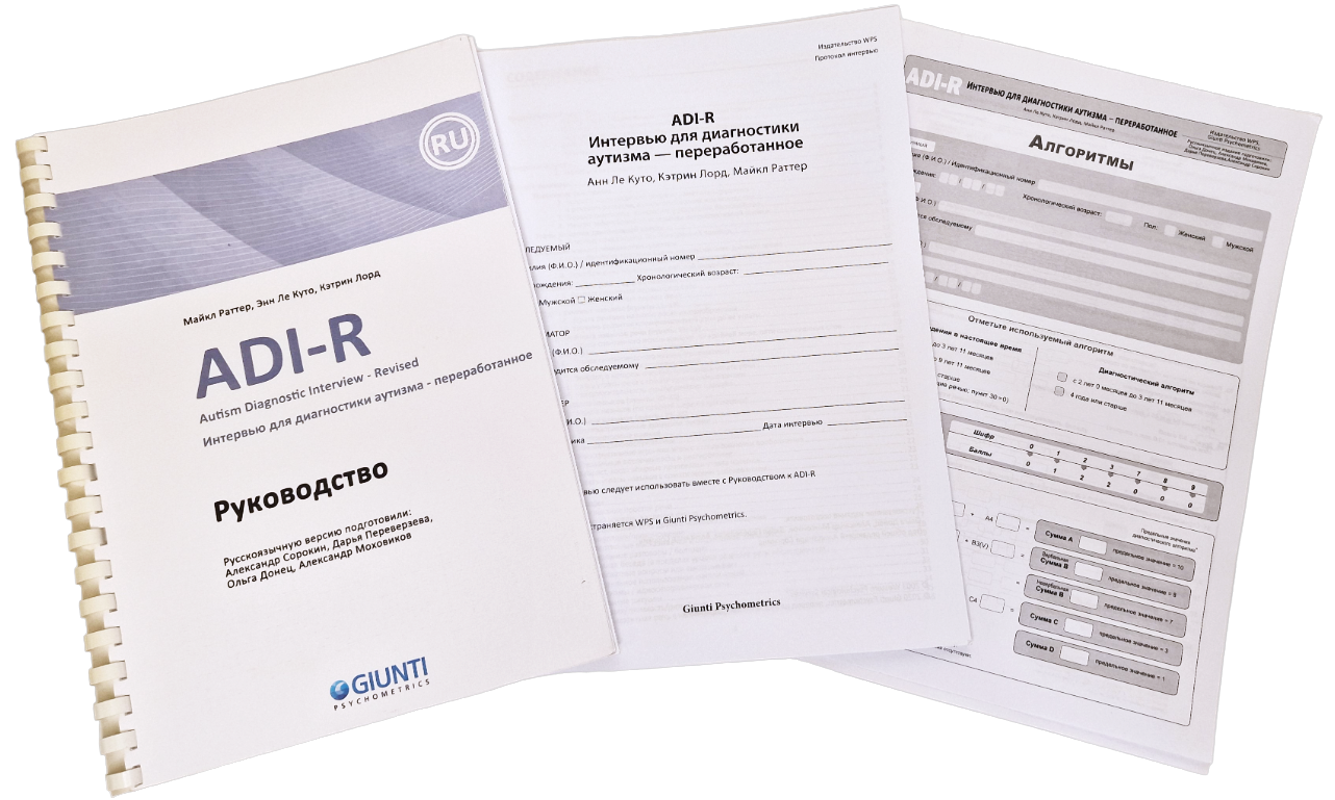
Autism Diagnostic Interview–Revised (ADI-R)
- Russian edition publication date
- 2013
- Russian-language adaptation
- Giunti Psychometrics Rus LLC
- Starter kit
- Manual, 10 protocols, 10 summary algorithms
- Respondents
- Parents and guardians of children from 2 years of age and adults with suspected autism
- Completion time
- 90 - 120 minutes
- Professional qualifications
- Diploma of higher education (specialty; master's degree; academic degree) in one of the following specialties: psychology, clinical psychology, medicine (neurology, psychiatry or pediatrics); it is recommended to undergo training in the practical application of the methodology.
- Copyright holder
- Western Psychological Services (USA)
- Assessment authors
- Michael Rutter, Ann Le Couteur, Catherine Lord
Autism Diagnostic Interview Revised (ADI-R) is a wide-ranging tool that provides a full range of information for differential diagnosis of autism spectrum disorder (PAC). Interviews are intended for parents and educators who have worked with autism patients with mental development for more than 2 years. ADI-R is recommended to be used in conjunction with the Autism Diagnostic Examination Plan (ADOS).
ADI-Ar is designed for systematic and standardized observation of aspects of behavior that have diagnostic value and meet the DSM-IV and ICD-10 criteria:
- language and speech;
- social interaction;
- Stereotypical behavior and narrowly focused interests.
The ADI-Ar is made up of modules, and there's only one module per subject, which is relative to the purpose of using this technique, which is to determine the diagnosis or the intervention, and the module is also selected according to age.
If the purpose of the examination is to make a formal diagnosis based on the history of the subject and assess the overall severity of the disease, one of two diagnostic algorithms is used (for 2.0-3.11 years or for 4.0 years or more). If the goal is to plan a treatment or build an educational program, one should use one of three current behavior assessment algorithms (up to 3.11 years / 4.0-9.11 years / 10.0 years and older).
The basic set includes a guide to use, a detailed protocol (86 pages A4) for entering the results of the interview (10 pieces) and a compact form (4 pages) of the algorithm for rapid quantitative assessment of violations (10 pieces) The interview consists of 93 questions, included in eight sections:
- background - to determine the general background of the family and therapeutic situation;
- Introductory questions – in order to outline the overall picture of the subject’s behavior;
- Report on early development;
- a number of questions concerning the age at which language skills were acquired and possibly lost;
- work with speech and communication;
- social development and play;
- interests and characteristics of behavior;
- General behavior - clinically important indicators such as aggression, self-harm and possible epileptic phenomena.